Tasked by the Public Prosecutor's Office of the Court of Milan, Tema Sistemi SpA replicated in the laboratories of Brand Technology the dramatic fire that, on the night of July 6-7, 2023, struck the RSA "Casa per Coniugi" in Milan, causing the death of six people and the intoxication of 81 others.
The incident, in all likelihood, and as per the report of the Fire Department's Fire Investigation Unit (NIA), had originated from a cigarette lit by a patient at the facility who was undergoing oxygen therapy. Embers or the cigarette itself, accidentally dropped, may, as the NIA report states, have started the fire.
The lady smoking died almost immediately, while the other woman in the room repeatedly called for help, but she, too, unfortunately passed away before they arrived. Four other elderly people died as a result of inhaling the toxic fumes.
Why reconstruct the accident
In addition to the various tests and trials carried out by Eng. Davide Luraschi and colleague Eng. Giovanni Cocchi, which also included evaluation with Fire Safety Engineering methods and field modeling with computational thermofluid dynamics (CFD) techniques, the reconstruction of the fire at the RSA "Home for Spouses" was a key step in fully understanding what happened that tragic night. The objective of the experiment was twofold: on the one hand, to reconstruct exactly the dynamics of the accident and the burden of the non-functioning of the 'smoke and heat detection system, and on the other hand, to assess whether the presence of an automatic fire protection system of active protection could have made a difference and prevented the tragedy.
To do so, Tema Sistemi recreated with extreme precision the room from which the fire originated. Every detail of the setting was taken care of, thanks also to the collaboration of the Teicos company, which took care of the transfer of the original furniture, taken from the RSA and kept by the NIA in Montelibretti (Rome). Every element of the environment was faithfully repositioned thanks to 3D surveying by Arch. Umberto Dubini, from structures to furniture, to ensure the most realistic simulation possible. All the material is that of the original RSA, from floors to wall coverings, medical equipment, mattresses, beds and blankets, to switches and lamps.
.jpeg?1751964037)
Test structure
The room and adjacent corridor were reconstructed with plasterboard walls and equipped with:
- Point smoke detectors
- Cameras
- Carbon monoxide (CO) measurement probes
- Thermocouples for temperature sensing
Two tests were conducted:
- First test (with IRAI and without active fire protection system): to observe the development of the fire and collect data on the dynamics of the incident as well as the timing of automatic fire detection.
- Second test (with IRAI with active fire protection system): to verify the positive contribution of an automatic sepgnization system. It was chosen to test the effectiveness of a water mist ASN type extinguishing system of the Aquatech® brand.
Tests were conducted in the presence of the NIA (Lombardy) and the ON RINA.
Trigger simulation
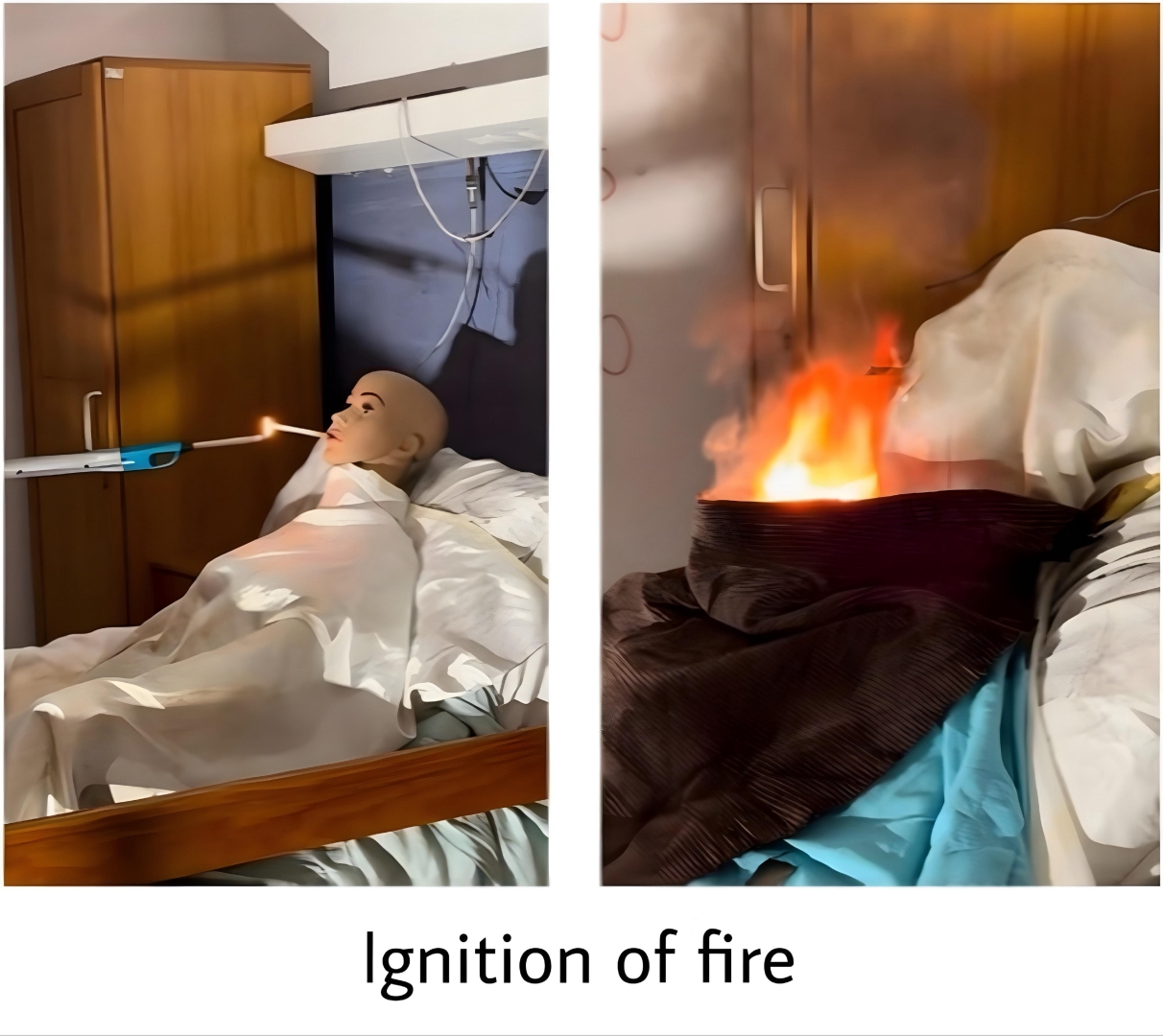
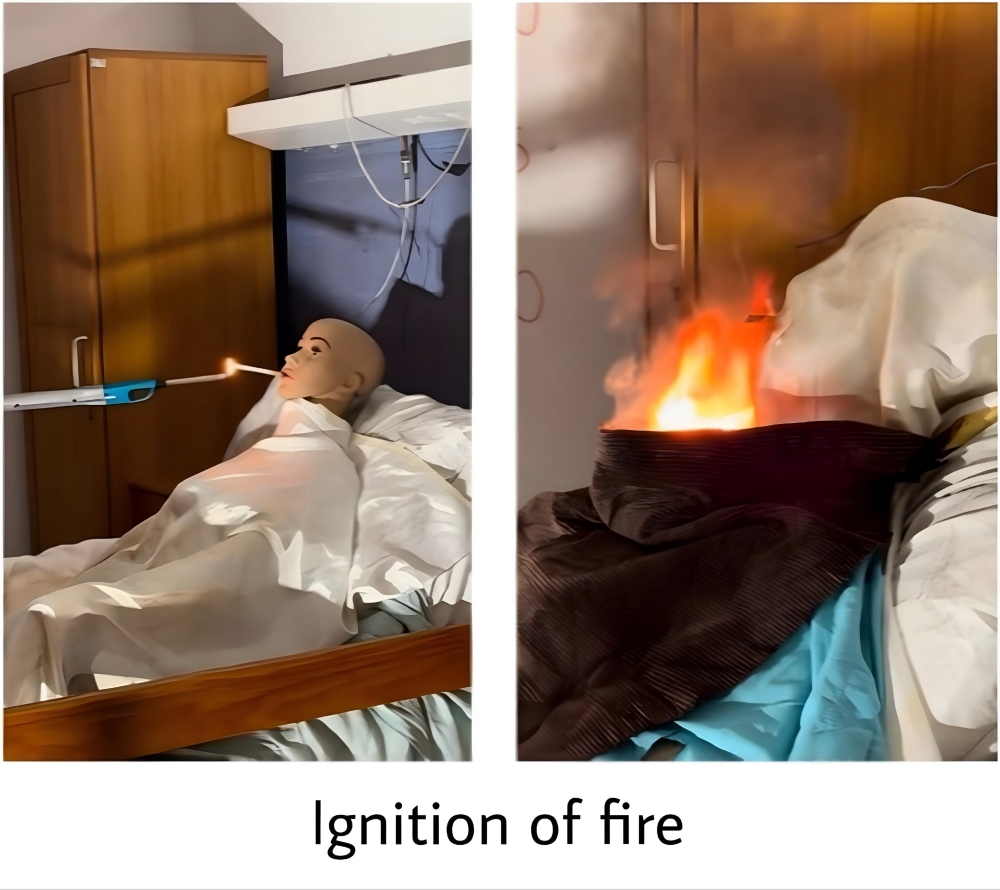
The initiation phase-under the supervision of NIA and Eng Luraschi-was carefully designed to reproduce the conditions of the accident. A dummy equipped with a device was used to simulate the act of smoking, the administration of oxygen (with the exact percentage of it), and the accidental dropping of embers.
TEST 1
In the first test, without an extinguishing system, the fire developed freely. Sensors recorded the rise in temperatures and carbon monoxide (CO) concentration at various points in the room. The test was stopped when the limit of 500 ppm CO was reached in all areas contextual to exceeding 1000°C at the ceiling.
Comment by CTU Ing. Davide Luraschi TEST1
The fire ignition occurred at 11:19:08 a.m. on November 13, 2024.
Over the next few minutes, flames began to spread gradually, initially affecting the bed and the plastic tube of the oronasal cannula. At the same time, a layer of hot smoke began to form under the soffit of the ceiling, which gradually thickened.
About five minutes after the start of combustion, then at 11:24:08 a.m., the smoke layer reached a lower level, reaching below the beam located above the head of the bed. Meanwhile, the flames had already reached a significant height. Burning material from flammable liquids leaked from the burning mattress was visible under the bed.
By the sixth minute (11:25:08), the layer of hot smoke had descended below the height of the bed.
Conclusions TEST1
Taking into account the typical operation of fire detection systems, which involve an initial pre-alarm stage upon detection of smoke by one sensor, and activation of the actual alarm upon confirmation by a second sensor, it can be said that the test conducted shows that if the facility's fire detection system had been properly functioning, it is likely that the alarm would have been triggered within about a minute and a half of the start of the fire. As early as the first detection (less than one minute), the system should have sent a pre-alert signal to the fire control center, making it possible for an operator to take initial action. Given the conditions present at the time - in terms of temperature and carbon monoxide concentration - such intervention could probably have changed the fate of the tragedy.
TEST 2
In the second test, triggering occurred in the same manner. After the first two smoke detectors were triggered, the pumping unit was activated after 10 seconds to simulate a signal transmission delay. Next, the water mist extinguishing system came into operation, which quickly contained and extinguished the flames.
Nozzle Model Used: water mist nozzle ASN by Aquatech®
Type: pop-up nozzle fully recessed into the ceiling
Technical Characteristics:
Droplet size: < 100 µm
Density of discharge: ≤ 1lt/m²
Does not cause damage to electrical equipment and furniture
Temperature-sensitive bulb with "Super Fast Response" automatic activation without the need for detection system
Anti-vandalism protective cover with no possibility of accidental tampering
Comment by CTU Ing. Davide Luraschi TEST2
The second test, was carried out with the aim of evaluating, in relation to the specific type of activity under analysis (RSA and more generally activities of type 68 or with the presence of people with reduced mobility or with delicate people-we also imagine kindergartens ), a possible strategy, voluntary, for the management of a fire even in critical conditions.
These environments accommodate patients with various pathologies and frailties, for whom evacuation may be particularly complex, often due to limited or absent autonomy of movement (the possible approach with patients with neuropsychiatric conditions is different)
Conclusions TEST2
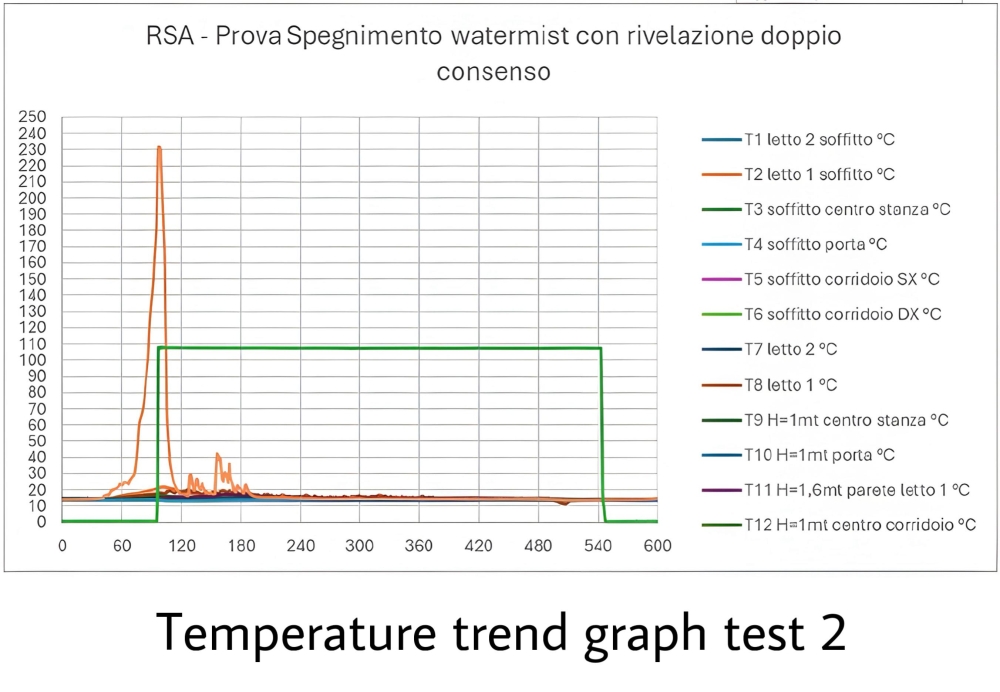
The test showed that in the presence of a water mist type active fire protection system, whether controlled by the smoke detection system or activated automatically independently, the fire is contained extremely quickly, minimizing temperatures and flame spread.
Tema Sistemi SpA's Aquatech® water mist system included No. 2 nozzles in the affected room and No. 3 in the corridor.
The stated operating pressure for the water mist system was 100 bar ± 10 bar, while the activation mechanism is based on the logic of double consent.
During the test, the maximum recorded temperature reached about 230°C at the point of flame development, while it remained extremely low in the rest of the room.
In addition, the maximum carbon monoxide concentration detected was 53 ppm inside the room.
These results indicate that in the presence of an active water mist protection system, the outcome of the fire would have been extremely favorable for the preservation of human life, the safety of people but also the protection of property.
Comparison of Parameters Test1 and Test2
|
Description
|
Test 1
|
Test 2
|
|
Max room temperature (trigger wall) (°C)
|
1030
|
231
|
|
Maximum temperature center bed 1 (°C)
|
830
|
20
|
|
Max bed center temperature 2 (°C)
|
100
|
14
|
|
Maximum ceiling temperature bed 1 (°C)
|
940
|
22
|
|
Maximum ceiling temperature bed 2 (°C)
|
591
|
14
|
|
Maximum corridor temperature (°C)
|
394
|
13
|
|
Max ceiling temperature center of room (°C)
|
630
|
17
|
|
CO max in the room (ppm)
|
500
|
53
|
|
CO max in the corridor (ppm)
|
500
|
7
|
Conclusions
In conclusion, the tests conducted clearly showed that the presence of an automatic fire suppression system, such as the Aquatech® water mist system, can be a crucial safety element in facilities that house people with reduced mobility, such as RSAs, hospitals, and clinics.
The temperatures recorded during the second test were significantly below the critical thresholds for human life, demonstrating the effectiveness of the system in containing the effects of a possible fire.
In addition, Aquatech®'s ASN system is certified to automatically activate at a temperature of 57°C, a feature that provides additional safety: even in the event of a failure of the detection system, the system will still go into operation, thus contributing to the preservation of human lives and the protection of facilities.






.jpeg?1750929405)
.jpeg?1750929576)
.jpeg?1750929792)
.jpeg?1750929942)
.jpeg?1750930043)
.jpeg?1750930101)